

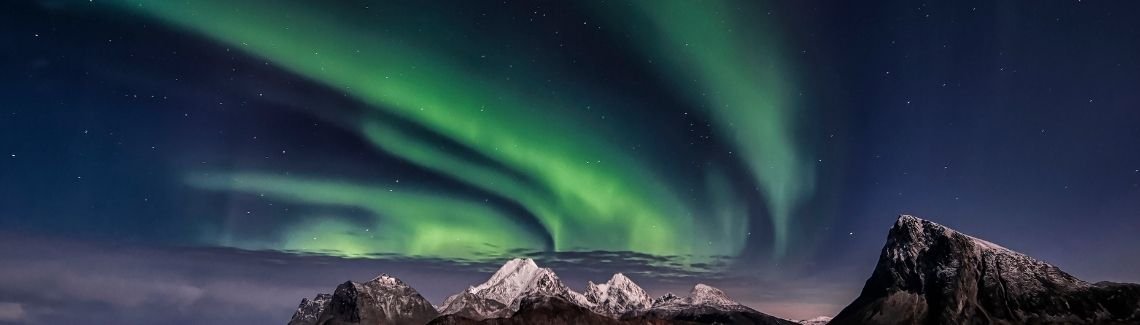
The awe-inspiring and sometimes-elusive Northern Lights are one of the biggest draws of winter travel to the northern Nordics. Though sightings are never guaranteed, the following information will help you maximise your chances of experiencing this spellbinding natural phenomenon.
Explore our Northern Lights tours →
The mesmerizing Northern Lights, or aurora borealis, are most visible above the Arctic Circle in northern Scandinavia, Finland and across Iceland during cold, clear winter nights.
The prime viewing season is typically from October to the end of March, with the highest likelihood of sightings between 18:00 and 02:00 hrs.
Clear, dark skies away from city lights greatly increase your chances of seeing this spectacular natural phenomenon.
The best chances of seeing the Northern Lights are found above the Arctic Circle, where long winter nights and minimal light pollution create ideal conditions for aurora displays. Some of the most reliable and spectacular locations in the world to experience the Northern Lights include:
The best places to see the Northern Lights are away from artificial city lighting, so outdoor excursions into the countryside or remote areas are highly recommended. Allow several nights for observations (cloud conditions can change quickly and unpredictably) and plan a variety of evening activities, such as dog sledding or snowmobile safaris, which not only provide exciting experiences in themselves but also take you into dark, open landscapes where the aurora are more visible.
Patience and dedication are key, as a cloudy evening can suddenly clear up, revealing the Northern Lights. Displays may last anywhere from a few minutes to several hours, so it is worth staying outside and enjoying the night sky.
Many hotels in Lapland and most countryside hotels in Iceland offer Northern Lights wake-up calls. Please check with the reception. Additional costs may apply.
Cruises along the northern Norwegian coast also offer excellent Northern Lights viewing opportunities, as most of the route is far from artificial light. You can enjoy the evening sky on deck, wrapped in a blanket, or on some ships even from an outdoor jacuzzi. Tour leaders will keep passengers informed of aurora activity throughout the night.
Please note that, as a naturally occurring phenomenon, the Northern Lights cannot be guaranteed, even under ideal conditions. No refund can be given for tours or activities if you do not see the Northern Lights.
The bright, dancing lights of the aurora are caused by collisions between electrically charged particles from the sun and the Earth’s atmosphere. These particles are drawn toward the magnetic poles, entering the atmosphere in a ring-shaped zone around the poles. In the Northern Hemisphere, they are called aurora borealis or Northern Lights, while in the Southern Hemisphere they are known as aurora australis. Most aurora displays appear green, though strong outbursts can also produce red, purple and other colours.